
Just a few short weeks ago, I joined a workshop lead by Sharon (ShU) LI, on working with SHIH at the Facilitation in Action conference in Geelong. The conference abstract said:
This highly interactive 90-minute session gives leaders a direct, embodied experience of Sun-Tzu's concept of SHIH — the art of creating advantage through positioning, timing, and the natural flow of events. Instead of pushing change or relying on pressure, participants experience SHIH as a felt sense of 'effortless advantage' and directly feel how positioning, timing, and the impact that small adjustments create.
The experience lingers in my being.
I arrived early. This gave me time to absorb the state of the space. Sharon had adorned the walls with some of Sun Tzu's sayings, or principles, and they would prove to be centres of gravity for group discussion and reflection on some very big questions.
Sun Tzu. A chinese sage philosopher, known well in the west for "The Art of War." But I know through Dad that his teachings were about so much more. This session helped me see, and connect with that more deeply than I'd done before. So timely too, as I was able to share this with him in his last days. That's probably contributing to why this session lingers so strongly in my thoughts, and why I've struggled to sit down and write about it. What happened in the room on the day for me, is only part of the story.
We started with some gentle, simple, energisers, to kindle connection with each other, and our context.
Sharon asked us to stand up, and keep standing for as long we could answer "Yes!" while she posed a series of questions.
- Have you heard of the IAF?
- Are you a member?
- Have you been to a conference?
- More than once? twice? three times?
Then we worked in pairs to mirror, lead, and cooperate in movement. Sharing reflections on the experience, what felt easier?
In a room full of facilitators the reflections were thoughtful, generous, insightful, and clarifying. There was space for difference.
Then we turned to SHIH.
The chinese character is drawn on butcher's paper and pinned to the wall at the front of room. It is surrounded by english words trying to creep up on its meaning. Disposition, potential, strategic advantage, influence. Configuration, force, energy, momentum.
We discuss the meaning. Ella says none of the words truly capture the meaning and intention of the pictogram. I ask her to tell the story she sees in the character. She sees the shape of Power, the Hand, and the Tool.
I come away feeling that "The Force" from Star Wars, might come close. Maybe.
These six statements were also up on the walls.
- Victory is found, not made
- Relying on the nature of things not changing them
- Inexhaustible - do not repeat the means of victory. But respond to form from the inexhaustible.
- Conflict is present whenever we engage the world. It is not the problem but rather the messenger of interdependence, of an important place where we are connected.
- Taking whole is finding a response to conflict that acknowledge interdependence, leaves the aspirations of the other intact, diminishes resistance, and uses SHIH to find enduring solutions.
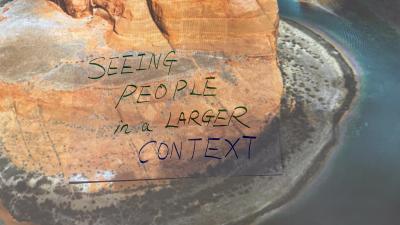
- Seeing people in a larger context.
The last of these was illuminated by changing slides of landscapes, which brought an extra something to its meaning.
I'm quite sure everyone will have experienced this session differently, with their own context shaping their responses and reflections.
For me, it was about Dad, who was invited to join a Sun Tzu society in China. I don't know which one. I wish I did. I wish I knew more. Maybe others will tell me those stories, now that he can not.
Finally, we turned to these words on the wall:
Employing SHIH is about:
- How a configuration of forces in a system focuses effective power
- Working with energy in a system at a deep level
- Seeing the details and the patterns they make
- Using existing conditions and energy
- How power is relational and is expressed both in action and as potential
- How energy in a system can be accumulated and released, like water behind a dam.
I'm left pondering this: How Might We arrange our spaces, our staff and stakeholders, our skills and structures in order to design systems and strategies, hear suggestions, and find solutions? How Might We harness our SHIH, collect our potential, and release that force for good?
As a facilitator? See people in their larger context. See the people. See the context. See the whole.